Optimisation Algorithms in Portfolio Construction
Portfolio optimisation aims to identify the most efficient asset allocation that maximises expected return while minimising risk. In classical finance, this objective is achieved through deterministic models based on mean–variance optimisation. However, the emergence of non-Gaussian return distributions, fat tails, and structural instability, particularly in crypto assets, has driven the development of new algorithmic families capable of navigating uncertainty and adapting to rapidly shifting market regimes.
These algorithms now range from classical convex optimisation to stochastic, metaheuristic, and AI-driven learning systems. Each approach brings distinct mathematical foundations, advantages, and limitations, and their suitability varies depending on the structure, liquidity, and volatility of the underlying digital assets.
Convex and Classical Models
The earliest optimisation paradigm, the Markowitz Mean–Variance framework (1952), formulates portfolio construction as a convex quadratic problem:
This model produces the efficient frontier of risk-adjusted portfolios under the assumption of normally distributed returns. Its analytical clarity and interpretability remain unmatched, yet it collapses in the presence of non-stationarity or fat-tailed distributions, both of which are endemic to crypto markets.
Robust Optimisation
Robust frameworks extend Markowitz by introducing uncertainty sets around estimated parameters to directly account for estimation error. The core problem with traditional Markowitz Mean-Variance Optimisation (MVO) is that it often maximises estimation error in volatile markets, treating historical data as perfectly accurate. Robust Optimisation (RO) solves this by seeking a portfolio that performs acceptably well in the worst-case scenario defined by these uncertainty sets, leading to superior stability and resilience against unexpected market shifts. They improve stability but tend to produce conservative portfolios, often under-allocating in high-volatility environments like crypto assets, as the model over-hedges against aggressive but potentially high-return strategies.
Mathematical Function
The objective function in a standard Robust Optimisation framework is designed to minimise the worst-case variance (risk) for a required level of return, considering the uncertainty in the estimated parameters.
Standard Mean-Variance Optimisation (MVO)
The classic MVO problem is:
Subject to: wᵀμ = Rtarget
∑wi = 1
wi ≥ 0
Robust Optimisation (RO)
The corresponding RO formulation, which incorporates uncertainty in the mean return (μ) and/or the covariance (Σ), can be expressed as:
Subject to: min( wᵀμ ) ≥ Rtarget
μ ∈ Uμ
∑wi = 1
wi ≥ 0
Where:
w: The vector of asset weights.
Σ: The estimated covariance matrix.
Rtarget: The required minimum return.
Uμ: The uncertainty set for the expected mean return (μ).
Redefining the Future of Intelligent Portfolio Management
While traditional models enhance portfolio stability, the future of intelligent portfolio management will move beyond passive risk aversion. Instead of systematically over-hedging volatility, our next-generation frameworks leverage adaptive intelligence to balance protection and performance, turning controlled exposure into a strategic advantage and enabling measured participation in high-conviction opportunities across volatile markets such as crypto assets.
The Crux
The key element is the constraint:
This forces the portfolio to meet the target return even in the worst-case scenario (the minimum realized return) within the predefined range of uncertainty (Uμ).
By accounting for this worst-case outcome, the resulting portfolio, w, is robust to estimation errors but is inherently conservative, it is willing to sacrifice potential maximum gain for guaranteed stability.
This trade-off explains why RO often yields low allocations in aggressive assets commonly found in crypto portfolios.
Advanced Optimisation: Metaheuristics & Reinforcement Learning
Metaheuristic and Evolutionary Algorithms
When markets are chaotic and multi-modal, deterministic solvers fail to find global optima. Metaheuristics, such as Genetic Algorithms (GA), Particle Swarm Optimisation (PSO), and Simulated Annealing (SA), offer stochastic search strategies inspired by natural processes.
- Genetic Algorithms: mimic evolution through selection and mutation; ideal for multi-objective optimisation but computationally intensive.
- Particle Swarm Optimisation: swarm-based approach with rapid convergence, efficient for continuous search spaces yet prone to premature convergence.
- Simulated Annealing: probabilistic exploration that avoids local minima but converges slowly.
These algorithms thrive in the crypto domain, where risk surfaces are highly irregular and discontinuous, enabling the identification of non-linear correlations and asymmetric return structures invisible to traditional methods.
Machine Learning–Driven Optimisation
The next generation of portfolio models integrates reinforcement learning, Bayesian inference, and probabilistic optimisation to adapt dynamically to market feedback. Reinforcement Learning (RL) views allocation as a sequential decision process, where an agent maximises cumulative reward under evolving market states.
Bayesian optimisation, on the other hand, frames the objective as a random function. It estimates uncertainty through Gaussian processes, allowing efficient exploration of unknown reward surfaces, an ideal trait in low-data, high-noise crypto environments.
Advantages of Learning-Based Frameworks
- Dynamic Adaptation: models evolve as new information streams in, maintaining regime awareness.
- Probabilistic Foresight: learns full return distributions, not just expected values.
- Behavioural Sensitivity: integrates sentiment and on-chain behavioural signals.
The Role of Quantitative Analysis in Modern Portfolio Construction
“Quantitative frameworks should enhance human judgment, not replace it, by revealing structural patterns invisible to intuition.”
Quantitative analysis serves as the analytical backbone of institutional portfolio design. Its purpose is not to dictate allocation decisions blindly, but to provide an empirical framework that transforms dispersed data into structured intelligence. From macro-level market indices to manager-level performance data, quantitative tools enable portfolio architects to assess exposures, isolate risk factors, and validate qualitative insights drill reproducible metrics.
The challenge lies in interpreting complex, non-normal return distributions, typical of hedge funds and crypto assets, where auto-correlation and opacity can distort traditional mean–variance assumptions. In this environment, quantitative analysis establishes numeric boundaries of rationality, helping managers identify outliers, calibrate exposure, and stimulate constructive debate between data and judgment.
Ultimately, quantitative frameworks promote consistency and transparency in decision-making, enabling risk managers and strategists to align portfolios not only with market dynamics, but also with their institutional mandates and liquidity constraints.
Our Portfolio Strategy Optimisation
Our optimisation framework extends classical mean–variance analysis through a fully stochastic Monte Carlo engine that integrates both historical dynamics and forward-looking volatility modelling. Instead of relying on static covariance matrices, we employ conditional volatility forecasts generated by GARCH and EGARCH processes to capture time-varying risk and asymmetric responses to market shocks, effects particularly pronounced in digital and alternative assets.
Our Optimisation & Simulation Framework
Each simulation iteration constructs a set of synthetic market scenarios consistent with observed correlations and volatility clustering. These scenarios are evaluated in parallel using a vectorised Monte Carlo approach, where thousands of portfolio weight configurations are tested simultaneously across multiple stochastic paths. This fine-grained parallelisation dramatically reduces computation time while preserving statistical accuracy.
The optimisation itself is multi-objective, balancing three risk-adjusted metrics, the Sortino ratio, the Calmar ratio, and the maximum drawdown.
Their relative importance is governed by user-defined weights transmitted directly from the front-end interface and automatically normalised. This ensures that the final allocation reflects the investor’s explicit risk–reward preferences rather than arbitrary parameter scales.
Once optimal portfolios are identified, Monte Carlo re-sampling and stress testing procedures are performed to assess stability under thousands of potential futures, including fat-tailed events and volatility spikes. This process validates not only the expected performance but also the robustness and rationality of the optimisation under non-linear, multi-modal risk surfaces.
- Conditional Volatility Modelling: GARCH/EGARCH processes estimate time-varying volatility paths, capturing leverage and clustering effects.
- Parametric & Bootstrapped Scenarios: Forward simulations combine historical correlations with stochastic volatility to generate realistic market trajectories.
- Vectorised Parallel Evaluation: Portfolio performance metrics are computed in batches to minimise computational overhead while maximising precision.
- Multi-Criteria Fitness Function: Dynamic weighting of Sortino, Calmar, and Drawdown metrics enables user-controlled optimisation targets.
- Resilience Validation: Stress tests and tail-event analysis confirm the portfolio’s structural robustness across simulated futures.
Quantitative Foundations of Intelligent Portfolio Optimisation
1. Quantitative Analysis as the Foundation
Quantitative analysis provides the mathematical and statistical backbone of portfolio management. It translates raw financial, behavioural, and market data into measurable parameters such as expected returns, volatility, correlations, and higher-order risk moments.
- Expected return: Mean of the return distribution.
- Volatility: Standard deviation as a proxy for dispersion and uncertainty.
- Correlation and covariance: Measures of inter-asset dependency.
- Higher-order moments: Skewness and kurtosis capturing asymmetry and tail risk.
- Probabilistic forecasts: Bayesian priors and posterior distributions.
These metrics define the input space of any optimisation process, before an algorithm decides how much to allocate, it must understand the statistical behaviour and dependency structure of each asset.
2. Portfolio Optimisation as the Decision Layer
Portfolio optimisation uses these quantitative parameters to determine the optimal allocation of assets given a utility function or constraint set, such as maximising risk-adjusted return (Sharpe, Sortino, or Calmar ratios) subject to drawdown or volatility limits.
Traditional optimisation (Markowitz mean–variance) assumes stable correlations and Gaussian returns, assumptions rarely valid in the non-linear and fat-tailed dynamics of crypto markets. Hence, stochastic simulation becomes essential to achieve robustness and adaptability.
3. Monte Carlo Simulation as the Probabilistic Engine
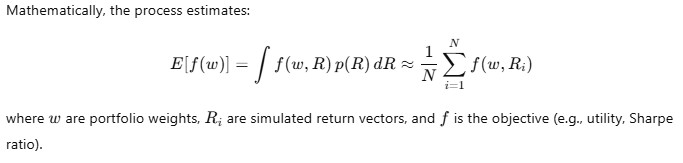
Monte Carlo methods extend classical optimisation by introducing randomised sampling of market states. Instead of relying on a single expected return and covariance matrix, the system generates thousands of synthetic scenarios of asset returns, correlations, and volatilities, effectively stress-testing portfolio configurations across a range of plausible futures.
- Captures non-linear dependencies and tail risks.
- Evaluates full distributional outcomes, not only mean–variance.
- Identifies robust allocations under uncertainty.
4. The Closed-Loop Between Analysis and Simulation
Quantitative analysis feeds statistical structure (parameters, priors, constraints) into the simulation, while Monte Carlo simulations generate empirical distributions of portfolio outcomes. This interaction forms a closed-loop feedback system where theory and empirical reality continuously align.
- Quantitative analysis defines the input model.
- Monte Carlo simulation provides validation and optimisation feedback.
- Together, they refine precision and model consistency iteratively.
5. Why This Matters for Crypto Assets
Crypto markets are non-stationary, highly correlated during stress events, and subject to structural shocks. Therefore, Monte Carlo–enhanced quantitative frameworks offer a superior approach by dynamically mapping risk surfaces and identifying allocation strategies that remain statistically sound even under extreme volatility.
Strategic Takeaway
The fusion of quantitative analysis and Monte Carlo simulation forms the foundation of intelligent portfolio construction, transforming risk modelling into a living, adaptive system capable of thriving in complex and unpredictable markets.
How it works?

Unlock the Future: Discover the New Standard in Crypto Risk
Sophisticated crypto investors require dynamic risk frameworks that account for the asset class's unique characteristics. By integrating advanced metrics with strategic diversification, portfolios can achieve institutional-grade resilience across all market conditions.